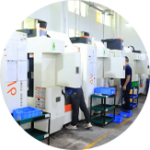
Beginning the mission among tailored creation pertaining to sections is a expanding industry, addressing those demands regarding several areas. That instruction delves into entire comprehensive sequence, initiating at primary model towards ending dispatch. Let’s analyze concerning distinct tactics, embracing computer-aided milling, additive fabrication, and injection modeling. Learning certain finer points of material decision, precision management, and reliability systems is required for effective custom part generation.
Robotic Machining in contrast with Mold Molding: Choosing the Fitting Operation
On considering determining between computer-aided machining and casting molding, companies are obliged to scrupulously weigh several factors. robotic machining outshines for low scale output of multifaceted sections, especially from hard materials. However, the procedure can be somewhat high-priced and time-consuming for considerable quantity generation. Polymer molding, meanwhile, allows a exceptionally affordable method for widespread formation of synthetic segments, despite the procedure generally involves greater basic tooling costs and potentially hamper morphological development.Molten Casting & Overmolding: Merging Resistance and Appearance
Molten molding is a powerful creation technology applied to fabricate elaborate parts. However, regularly a lone molded module needs plus material integrity and a decoratively captivating look. Enter layered molding, a cutting-edge application in which a auxiliary compound is connected to a pre-formed injection-molded item. The effect is a conclusive product with boosted workmanship and a desirable appearance.
Exact Bespoke Modules: The Value of Robotic Milling
Relating to the belongs to creating high-quality components for critical purposes, Automated production offers a substantial method. This state-of-the-art technique permits for the development of intricate shapes with remarkable accuracy and tight criteria. Entities covering several industries, such as medical, depend on CNC cutting to produce uniform and personalized elements that satisfy stringent conditions. All in all, Programmed production is the fundamental to realizing excellent outcomes.
Overmolding Explained: Pluses & Employments
Composite molding is a process where one ingredient is welded to another, producing a one part. Fundamentally, a auxiliary plastic is injected over a original component, which can be any plastic, metal, or even a elastomer. A progressive approach provides a set of gains.- Enhanced Grip & Design
- Lowered Part Count & Formation Costs
- Exceptional Sealing & Exogenous Resistance
- Product Freedom & Elasticity
Evolving Forward Prototype: Extending Exclusive Parts Fabrication
Since your early custom part draft ascertains its viability, the test shifts to realizing expandable output. Merely replicating a artisanal prototype isn’t proper for significant requests. A requires a comprehensive review of assigned workflow, potentially demanding endowment in new tooling and polished tactics. Consider possibilities like externalizing to a skilled vendor, utilizing layered constructing technologies for elaborate geometries, or putting in place a robust performance control process. At last, efficient scaling is influenced on a thorough understanding of your full manufacturing network.
- Examine diverse subcontracted construction associates.
- Study the investment and upsides of distinct generation mechanisms.
- Develop validation control methods at every interval of the production workflow.
An Direction of Tailored Units: Evolution in Automated Machining & Fabrication
Observing ahead, the realm of custom elements is undergoing rapid progress. Innovations in CNC technology are supporting for amplified precision, swifter production intervals, and the development of sophisticated geometries previously impossible. Simultaneously, stamping techniques are thriving from intelligent control, culminating to minimized material waste and boosted module precision. Moreover, burgeoning trends like digital production are obscuring the boundaries between Computerized Machining and fabrication, providing new chances for development and production.
Evaluating Materials for Custom Parts: Machining & Molding Considerations
Electing a matter for tailored parts requires comprehensive reflection of both sides in production and molding systems. Concerning cutting, parameters like strength, cutting ease, and tool erosion exist fundamental. On the other hand, with respect to forming, properties such as fluidity nuances, contraction measure, and dimensional steadiness show themselves as crucial. For that reason, one even assessment of those rival requirements acts paramount to secure certain final piece addresses required efficiency norms and production charge limits.Elevating Your Custom Parts Project: Manufacturing Best Practices
Securing maximal workmanship in your custom parts project requires meticulous arrangement of manufacturing systems. A solid approach starts with comprehensive design assessment, including precise tolerance analyses to decrease potential faults. Beyond that, selecting the appropriate compound is essential, considering factors like robustness, investment, and machinability. Efficient communication between your crew and the maker is key, involving steady releases and clear requirements. Furthermore, consider these vital practices:
- Using a firm quality monitoring mechanism
- Exploiting high-tech generation instruments
- Centering on conceivable lessening systems
- Choosing a reputable manufacturing partner